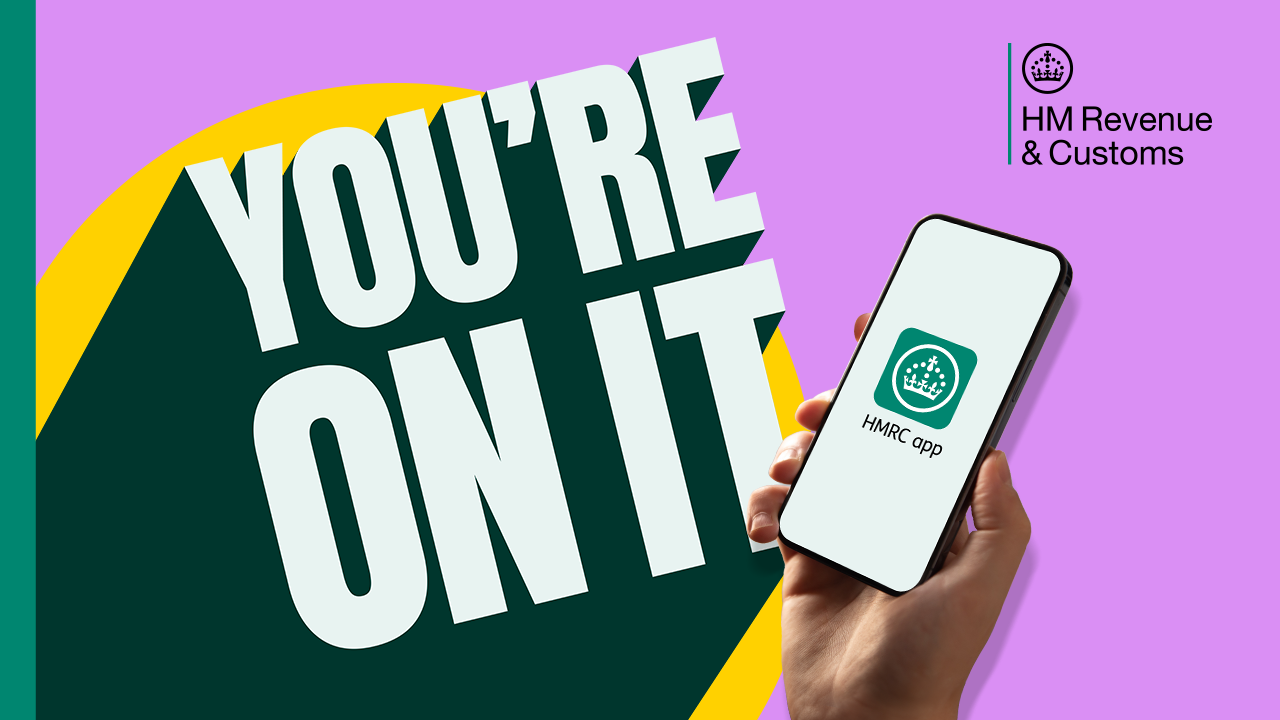
HMRC’s Transformation Roadmap sets out a clear ambition: to make everyday tax interactions simpler and more intuitive to meet customer needs. The increased traffic to the HMRC app this year reflects HMRC’s longer‑term ambition to make it easier for customers to self‑serve on straightforward tasks.
Decisions about what to prioritise, how to communicate and where to intervene are shaped by service data, user research and behavioural insight. This allows us to identify where customers commonly experience friction, delay or uncertainty, and to design targeted prompts, messages and content that encourage earlier, simpler action. By aligning communications with real customer behaviours and moments of need, we’ve been able to drive meaningful uptake and sustained engagement with the HMRC app as part of everyday tax interactions.
This data led approach to behaviour change has supported sustained adoption of the app, which has encouraged:
- more than 4.2 million HMRC app downloads in 2025
- more than 136 million logins, a 20% increase on 2024
- older and retired people are the largest growth area for app engagement
From parents to pensioners, millions of people across the UK are increasingly using the app to stay in control of their money and tax. Record numbers are regularly using it to:
- Check State Pension forecasts: A major rise in new users aged over 55 and nearly 2.4 million people viewing their forecast in 2025 - up from 1.7 million in 2024, an increase of nearly 664,000 users.
- Claim and manage Child Benefit: Almost 960,000 people used the Child Benefit area of the app in 2025 - 160,000 more than in 2024. Hundreds of thousands of families used it to get the money they were entitled to with 159,000 parents extending their Child Benefit for teenagers staying in education (up from 109,000), and sessions increasing to 250,900 (up from 185,600).
- Find their National Insurance number: Saving NI numbers to the digital wallet remained one of the most popular reasons to use the app. 383,000 people stored their NI number in 2025 so they always have it handy - 70,000 more than the previous year.
HMRC has embedded the app into the wider service ecosystem, supported by a strong, insight-led communications approach. The creative approach has been designed to stand out against a busy media landscape and resonate with our customers in a fun and distinctive way. Whether it's the surreal charm of a bathtub limo and rubber duck serenade, or the offbeat oddity of a yeti in the fridge, we’ve captured that feeling of being in control – even when life gets chaotic.
Take a look at the HMRC adverts here:
You’re on it 2.0 – Download the HMRC app
You’re on it – Download the HMRC app
The increase up-take of self-serve interactions has reduced telephony contact, supported departmental efficiency savings and has allowed HMRC to focus more telephony resource on complex cases and customers who need additional support.
For teams across government, HMRC’s experience shows how digital transformation is not just about building new tools, but about using insight to shape how we communicate changes and how services are experienced at scale, ensuring they fit naturally into people’s lives.
How you can help
Download and explore the HMRC app to quickly and easily access a wide range of services, with guidance available on GOV.UK. Recommend the app to family and friends to help more people self-serve online and free up advisers for those who need extra support.
Leave a comment